Government Exam Typing Test
Practice for SSC, Railway, High Court and CPCT with real exam conditions
SSC Standard: English 35 WPM, Hindi 30 WPM (10 min)
Calculation: Net Speed = (Total Characters / 5) − Errors
OF TYPING PERFORMANCE
Candidate Name
For successfully completing an Online Typing Practice Test on MultiTyping.in and achieving the performance results shown below.

Free Online Typing Test for CPCT, SSC CGL, Railway & High Court Exams — With Full Analytics
If your government exam has a typing round, this is the practice tool built for it. Select your exact layout — Hindi Krutidev, Mangal Inscript, Remington Gail (CPCT) or English QWERTY — set the duration that matches your exam, and type. Backspace and paste are locked out in exam mode so your practice WPM is your real WPM, not an inflated one you will never see on exam day.
But what happens after the test is where this tool goes further than anything else you will find free online. The results screen gives you a full analytics dashboard: a Pass / Fail exam verdict, your Skill Rank & Percentile among all users, a Personal Best tracker, a daily Streak counter, a Weak Keys & Accuracy Breakdown with an instant 2-Minute Weak-Key Drill, a local 10-Attempt Speed Progress Chart with a Daily Goal badge, a Smart Next-Practice Recommendation, contextual Related Practice Hubs, a Student Community card, and a QR-verified Practice Certificate — all completely free, all without creating an account.
Typing Speed Requirements for Government Exams (2025–26)
Every recruitment board sets its own qualifying speed, keyboard layout and test duration. Before you start practising, confirm exactly what your target exam demands — training on the wrong layout or the wrong duration is the single most common (and most avoidable) mistake aspirants make.
| Exam / Post | English | Hindi | Duration | Layout | Backspace |
|---|---|---|---|---|---|
| CPCT Typing Test MP Govt — All Departments |
30 WPM | 25 WPM | 15 min | Remington Gail | Disabled |
| SSC CGL / CHSL Typing Test DEO / LDC / Tax Assistant |
35 WPM | 30 WPM | 10 min | Mangal / Krutidev | Disabled |
| Allahabad High Court Typing Test RO / ARO / Steno / Typist |
30 WPM | 25 WPM | 10 min | Mangal Inscript | Disabled |
| Railway RRB Typing Test Junior Clerk / Typist |
30 WPM | 25 WPM | 10 min | Mangal Unicode | Disabled |
| UP Police / SI / ASI Typing Test | 25 WPM | 25 WPM | 10 min | Mangal / Krutidev | Disabled |
| Banking / IBPS / SBI Typing Clerk / PO Data Entry |
30 WPM | — | 10 min | QWERTY English | Disabled |
| State PSC / Secretariat Typist | 30 WPM | 25 WPM | 10 min | Exam Specific | Disabled |
* Speed requirements can change with each new recruitment notification. Always cross-check the numbers above against your official exam notice before test day.

Live typing interface with real-time Gross WPM, Net WPM, accuracy and error tracking
Why Aspirants Choose MultiTyping.in Over Other Free Tools
There is no shortage of free typing test sites. Here is what actually sets this one apart when you are preparing for a timed, high-stakes government exam.
CPCT-Accurate Exam Mode
Practice on the Remington Gail layout with a 15-minute timer and backspace fully disabled — identical to the actual CPCT test screen.
Every Layout You Need
Krutidev 010, Mangal Inscript, Remington Gail, Unicode Hindi, English QWERTY, and nine regional language layouts — all in one place.
Live WPM & Accuracy Bar
Gross WPM, Net WPM, accuracy percentage and error count all update live every second using the same formula government examiners use.
High Court Typing Practice
Dedicated passages built around legal vocabulary for Allahabad, Delhi, Rajasthan and MP High Court recruitment exams.
Paste & Backspace Blocked
Ctrl+V, right-click paste and drag-and-drop are all blocked in exam mode so your practice score reflects your genuine skill level.
Weak Keys Breakdown & 2-Min Drill
See the top 5 keys you mistype most. One click launches a 2-Minute Weak-Key Drill targeting those exact characters with home-row placement tips.
Local 10-Attempt Progress Chart
Your last 10 scores are saved in your browser with an SVG trend chart vs. the qualifying target line and a 3-tests/day Daily Goal tracker — no login needed.
Skill Rank, Percentile & Streak
Get a Skill Rank (Beginner to Master), percentile standing, Personal Best badge and a daily streak counter — all updated live after every test.
Smart Practice Recommendation
Below cutoff? Get an Accuracy Booster recommendation. Above cutoff? Get an Advanced Exam Simulation challenge — personalised to your score and language.
QR-Verified Practice Certificate
Generate a shareable PDF certificate with your name, WPM, accuracy, date, unique Certificate ID, and a QR code for online verification — free every time.
Works Everywhere, Best on Desktop
Runs on any screen size, but a physical keyboard on a laptop or desktop gives results closest to the real exam environment.
Completely Free, No Sign-up
The typing test, weak-key drill, progress chart, leaderboard, certificate and community chat are all free — no account, no hidden paywall.
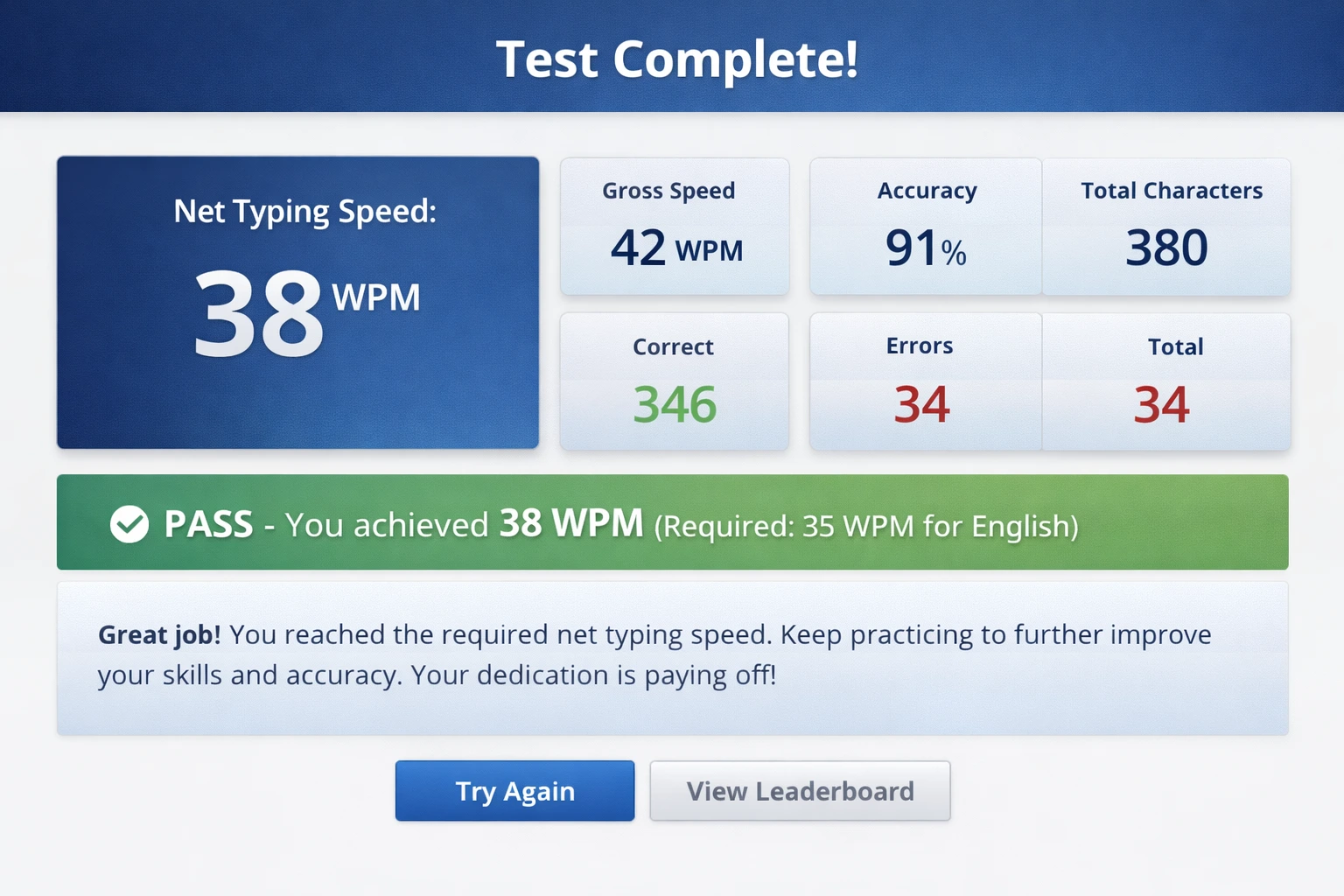
Detailed results breakdown with Pass/Fail verdict, Skill Rank, Percentile and Personal Best
How to Take the Typing Test — Step by Step
Pick the Language & Layout Your Exam Uses
Choose Remington Gail for CPCT. For SSC CGL or High Court go with Krutidev 010 or Mangal Inscript. For English rounds, select QWERTY. Matching the exact layout named in your exam notification is what actually builds usable muscle memory.
Set the Duration to Match Your Exam
Use 10 minutes for SSC, Railway and High Court tests, and 15 minutes for CPCT. The countdown behaves exactly like a real computer-based test so you also get used to pacing yourself across the full duration.
Choose a Difficulty That Matches Your Level
Start on Easy if you are new to the layout. Move to Medium once you are comfortable — this is your exam-realistic zone. Switch to Hard only after you are consistently clearing the required speed.
Keep "Disable Backspace" Turned On
This one setting matters more than any other. Government typing exams never allow backspace. Practising with it off teaches a habit you will have to unlearn under pressure. Let mistakes happen and keep going — that is exam mode.
Add Your Name for the Leaderboard (Optional)
Your score gets logged on the live leaderboard and printed on your practice certificate. It is a nice way to track your own progress over time and compare with other aspirants.
Type the Passage — Accuracy First, Speed Second
Click into the text box and start typing. Don't rush the first few lines. The top bar updates your Gross WPM, Net WPM, accuracy and error count live, every second.
Watch Your Net WPM — That Is the Number That Counts
Green text means correct, red means an error. Net WPM is what examiners actually check, so keep it above your target cutoff throughout the test, not just at the end.
Read Your Full Post-Test Dashboard
Once time runs out, scroll through your results: Pass/Fail verdict, Skill Rank, Percentile, Personal Best, Streak, Weak Keys Breakdown, 2-Min Drill, Progress Chart, Smart Recommendation, Practice Hubs, and your Certificate download — all in one screen.
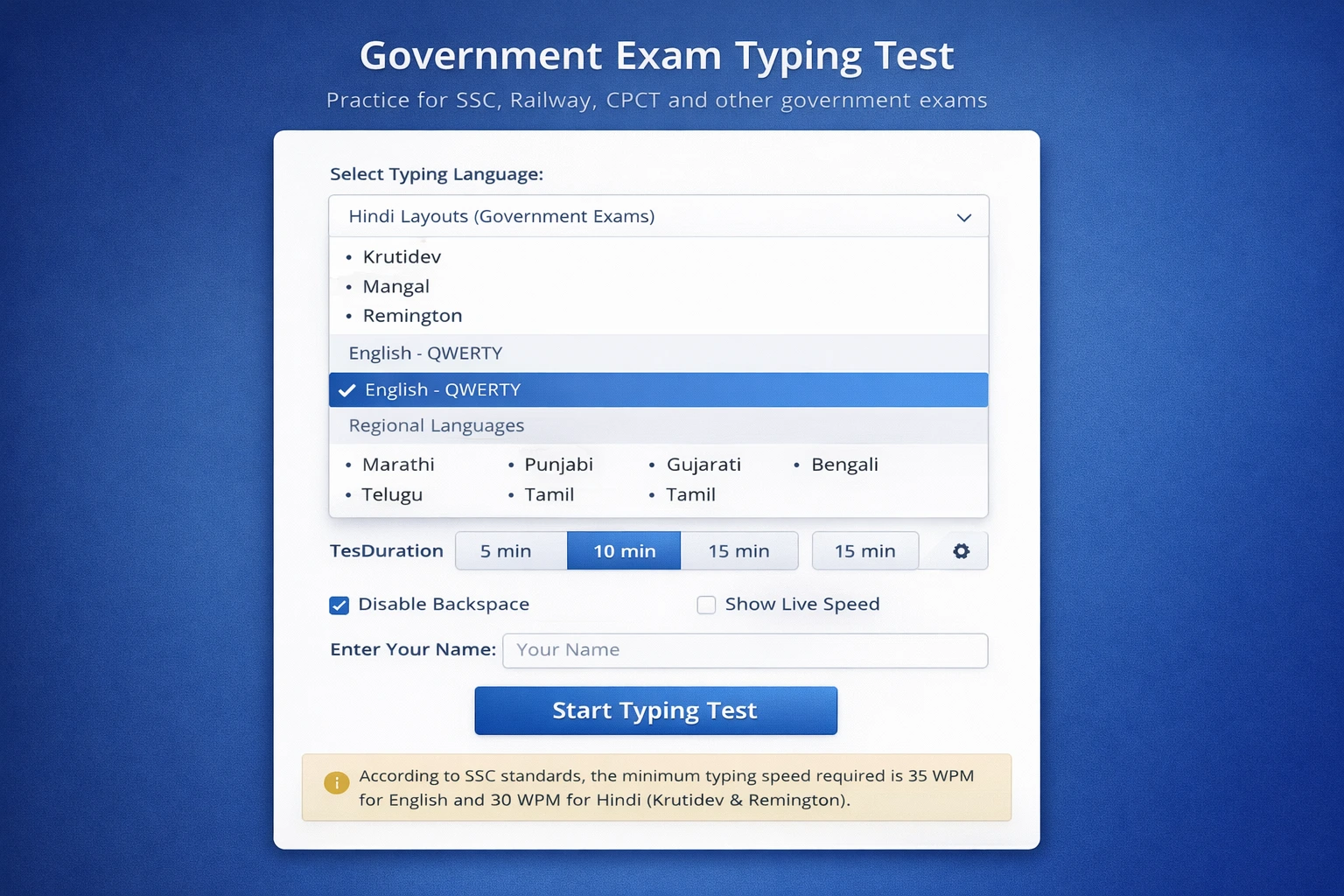
Simple setup screen — pick your exam layout, duration and difficulty in seconds
💡 How to Actually Increase Your Typing Speed
Most candidates plateau because they chase speed before accuracy is solid. These are the habits that reliably move the needle, based on how government typing tests are actually scored.
Net speed is gross speed minus your error penalty. A single mistake is genuinely expensive. Slow down until every character lands correctly, and once your accuracy holds above 90%, your speed will start climbing on its own. Chasing raw speed before accuracy is stable almost always backfires on exam day.
Typing is a muscle-memory skill. Twenty to thirty focused minutes daily — one CPCT-style test in the morning, one SSC-style test in the evening — will improve your speed faster than a single long session once a week. Use the Daily Goal badge (3 tests/day) on the results screen to build this habit.
If your exam runs on Krutidev 010, train only on Krutidev. If it is CPCT, stick to Remington Gail. Switching layouts mid-preparation resets your finger memory and slows you down. Pick the layout named in your notification and stay with it through the entire preparation window.
Real SSC, Railway and CPCT exams do not let you correct mistakes with backspace. If you have been practising with it enabled, the exam interface will feel unfamiliar and stressful on the day. Keep "Disable Backspace" checked in every session so your practice conditions match the real thing.
After each session, check your Weak Keys Breakdown — the coloured pills showing which keys you missed most (e.g. r — 2 misses, a — 1 miss). Then hit the "Start 2-Minute Weak-Key Drill" button. That focused micro-test isolates exactly those problem characters and rebuilds muscle memory for them in under two minutes — far more efficient than just repeating full tests.
Sit upright, screen 50–60 cm away, fingers anchored on the home row (ASDF JKL;), wrists flat and slightly hovering. Candidates who learn proper touch-typing technique typically reach 40–50 WPM within two to three months of consistent practice.
Your local 10-attempt chart shows you whether your Net WPM trend is going up or down relative to the qualifying target line. Set a specific weekly goal — "hit 32 WPM net speed by Sunday" — instead of a vague one like "get faster". Small, measurable targets are far more motivating than open-ended ones.
Understanding Your Typing Test Results
After every test you get a detailed results screen. Here is what each number means and how it lines up with the actual government exam evaluation process.
📈 Net Typing Speed (WPM)
Your qualifying speed.
( Total Characters ÷ 5 − Errors ) ÷ Time (minutes)
SSC English minimum is 35 WPM; CPCT Hindi minimum is 25 WPM.
📉 Gross Speed (WPM)
Your raw speed before error deduction.
( Total Characters ÷ 5 ) ÷ Time (minutes)
Aim for a Gross speed at least 8–10 WPM above your required Net speed as a safety buffer.
✅ Accuracy %
( Correct Characters ÷ Total Characters ) × 100
Most exams expect at least 90% accuracy alongside the minimum speed requirement.
❌ Error Count
Every error directly reduces your Net WPM. In a 10-minute test, 20 errors costs roughly 2 WPM — enough to push a borderline score into a fail.
🔢 Total Characters
All keystrokes typed, correct and incorrect combined. A higher count gives your net speed a higher ceiling to work with.
✔️ Correct Characters
Characters that exactly matched the passage. This drives both your accuracy percentage and your net speed — keep this your main focus.
🏅 Everything You Get After the Test — The Full Results Dashboard
Most free typing tools give you a WPM number and nothing else. MultiTyping.in gives you a complete post-test analytics dashboard — all stored locally in your browser, no account needed. Here is exactly what appears on your results screen and why each piece matters for your exam prep.
✅ / ❌ Exam Pass / Fail Verdict & Motivational Message
The first thing you see at the top of the results is a clear Pass or Need More Practice notice based on the standard qualifying cutoff for your chosen language (35 WPM English / 30 WPM Hindi for SSC, 30 / 25 WPM for CPCT). Below that, a motivational message adjusts to your situation — whether you just scraped past the cutoff, need to tighten accuracy, or are well above the target and ready for harder passages.
🏅 Skill Rank, Percentile, Personal Best & Streak Badges
Four colour-coded badges appear just below the results grid, giving you instant benchmarks beyond the raw score:
- 🥈 Rank: Beginner (<25 WPM) → Intermediate (25–39 WPM) → Advanced (40–54 WPM) → Master (55+ WPM)
- 🏆 Percentile: e.g. "Top 65% (Developing)" or "Top 25% (SSC Qualified Level)" based on your net WPM relative to all users
- 🔥 Personal Best: Flashes "🔥 NEW PERSONAL BEST!" in amber if you beat your all-time high speed, stored in your browser's local storage
- ⚡ Streak: Counts consecutive days you have taken at least one test — keeps motivation high through long prep windows
🔄 Action Buttons — Try Again, Share, Certificate & More
A full set of action buttons sits below the badge strip so your next step is always one tap away:
- 🔄 Try Again — resets with the same settings for instant re-practice
- ⚡ Try Harder Level — jumps straight to Hard difficulty in one click
- 📲 Share Result — copies your scorecard text for WhatsApp / social sharing
- 📜 Get Certificate — generates a QR-verified PDF certificate with your name and score
- 🏆 Leaderboard — see your ranking among all aspirants
- 📝 CPCT MCQ — jump to multiple-choice computer knowledge practice
- 💬 Student Chat / 👥 Community — connect with fellow aspirants instantly
🔍 Weak Keys & Accuracy Breakdown — Know Exactly Where You Lose WPM
The system analyses every keystroke and surfaces the top 5 keys you mistyped most often as coloured pills showing each key and its miss count — for example r 2 misses · a 1 miss · e 1 miss · l 1 miss · o 1 miss. Below the pills, a Practice Tip reminds you to anchor your fingers on the home row and slow down on those exact keys during your next attempt.
📈 Recent Attempts — Speed Progress Chart & History Table
Every attempt is automatically saved to your browser's local storage — no server, no sign-up. An interactive SVG line chart plots your Net WPM across the last 10 tests in chronological order (oldest left, newest right), with a dashed gold Qualifying Target line (35 WPM for English, 30 WPM for Hindi) so you can see at a glance whether your trend is rising above or still below the cutoff. Each data point shows your exact WPM and attempt number.
A clean attempt history table below the chart lists each attempt: Time, Language, Net Speed (highlighted badge), Gross Speed, Accuracy %, and Error count (red if any errors, green if flawless).
🎯 Smart Next-Practice Recommendation — Accuracy Booster or Exam Challenge
The recommendation card updates dynamically based on your language and score so your next step is always relevant:
- English below 35 WPM → "Accuracy Booster Recommendation"
Recommends: English 5-Min Rhythm & Accuracy Practice — "Maintain >95% accuracy to easily cross the SSC English cutoff of 35 WPM." - English 35 WPM+ → "Advanced Exam Challenge"
Recommends: High Court / BSF HCM Exam Simulation — push speed with harder passages. - Hindi below 30 WPM → "Skill Booster Recommendation"
Recommends: Hindi Mangal/Inscript Accuracy Practice — focus on vowel matras and conjunct characters. - Hindi 30 WPM+ → "Next Exam Challenge"
Recommends: CPCT Hindi Typing Simulation — test with actual CPCT passages and 15-minute time limit.
🔗 Related Practice Hubs — Your Next Stop in One Click
Three quick navigation pills appear right below the recommendation card so you can jump straight to what you need next without hunting through menus: 🏛️ All Government Exam Hubs (index of every state and central typing exam), 📏 Typing Speed Calculation Rules (how net WPM and error penalties are officially evaluated), and ⚖️ High Court Typing Test (dedicated legal-passage practice), plus 📝 CPCT MCQ Practice right in the results action bar.
👥 Don't Stop at One Test — Join the Student Community
Right after your results, a dark-gradient community card invites you to connect with thousands of SSC, Railway, CPCT and High Court aspirants who are preparing alongside you. 💬 Join Student Chat takes you to the live chat room where people share WPM scores, ask doubts and get exam updates in real time. 👥 Explore Community leads to the broader MultiTyping aspirants forum. Preparing with others dramatically improves consistency — isolation is one of the biggest reasons candidates plateau and lose motivation. Below the community banner, you will also see a quick Enjoying MultiTyping? Rate on Trustpilot card where your 30-second review helps other government exam students find a genuinely free practice platform.
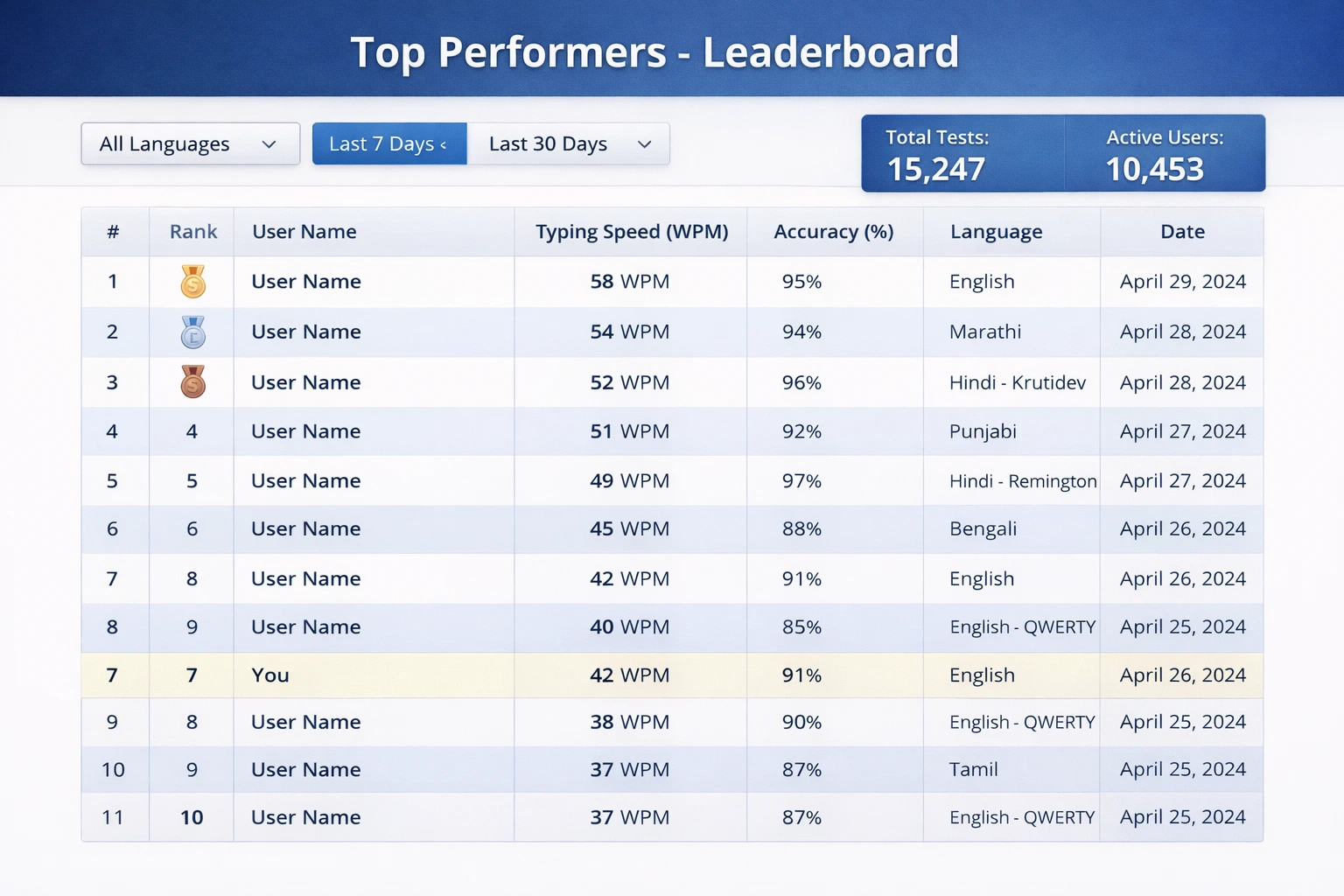
Track your progress and see how you rank among thousands of aspirants
Exam-by-Exam Typing Preparation Guide
🖥️ CPCT Typing Test — Full Guide
The Computer Proficiency Certification Test (CPCT) is conducted by MP State Agency for Promotion of Information Technology (MAP-IT) and is mandatory for most Madhya Pradesh government roles that involve computer work. The typing round runs for 15 minutes in both Hindi (Remington Gail) and English (QWERTY), with a required speed of 30 WPM English or 25 WPM Hindi. Backspace, delete and cut are all disabled during the actual test.
📋 SSC CGL / CHSL Typing Test Rules
The SSC typing test is a qualifying skill test for Data Entry Operator, LDC and Tax Assistant posts — it doesn't count toward your merit score, but you must clear it to be considered. English candidates need 35 WPM net speed; Hindi candidates need 30 WPM, typed on Mangal or Krutidev. The test runs for 10 minutes, and every error directly reduces your qualifying net speed.
⚖️ High Court Typing Test — RO / ARO / Typist
The Allahabad High Court typing test and similar state High Court exams are required for RO, ARO and Computer Operator posts. Minimum speed is typically 25–30 WPM for Hindi (Mangal Inscript) and 30 WPM for English. Passages often include legal terminology, so familiarity with court vocabulary genuinely helps — select Hard difficulty to train on legal-vocabulary passages.
🚂 Railway RRB Typing Test — Junior Clerk / Typist
Railway typing tests for Junior Clerk, Typist and Accounts Clerk posts require 30 WPM English or 25 WPM Hindi on Mangal Unicode, over a 10-minute duration with no backspace. The net speed formula is identical to SSC's — gross speed minus errors per minute.
📚 Essential Typing Guides & Exam Strategy
Clear, practical blueprints covering WPM calculation formulas, touch-typing finger ergonomics, and 45-day exam preparation routines.
Government examination boards (SSC, CPCT, High Courts, RRB) standardise words as 5 keystrokes (including letters, spaces, and punctuation). Official evaluations use these exact equations:
- Gross Speed (WPM):
(Total Characters Typed ÷ 5) ÷ Time (Minutes) - Net Speed (WPM):
Gross WPM − (Total Errors ÷ Time in Minutes) - Accuracy Percentage:
(Correct Characters ÷ Total Characters) × 100
Practical Example: If you type 1,750 characters in 10 minutes with 15 errors: Gross Speed = (1750 / 5) / 10 = 35 WPM. Error penalty = 15 / 10 = 1.5 WPM. Qualifying Net Speed = 35 − 1.5 = 33.5 WPM. A single mistake directly shaves off your net score, which is why accuracy always trumps reckless speed.
Most failed candidates in SSC, CRPF, and High Court exams achieve 40+ WPM on home practice tests yet get disqualified on exam day. Why? Because of the permissible error cutoff (typically 3% to 5%).
In exam conditions where backspace is disabled, every error triggers a compounding penalty. Typing at 35 WPM with 98% accuracy qualifies easily, whereas typing at 48 WPM with 86% accuracy leads to immediate disqualification. When practising on MultiTyping, treat 95% accuracy as your non-negotiable floor before trying to push speed higher.
Follow this tested 3-phase progression to build speed and accuracy from zero to qualifying level:
Anchor fingers firmly on the home row (ASDF JKL;). Never glance down at your hands. Practice 25 minutes twice daily on Easy and Medium passages. After each session, run the Weak-Key Drill on your top mistyped keys.
Keep "Disable Backspace" permanently on. Focus on capital letters, complex punctuation, and Hindi conjunct matras (हलन्त/संयुक्ताक्षर) until accuracy stabilises above 95%. Check your 10-attempt Progress Chart daily to confirm the upward trend.
Take full-duration timed tests on legal and editorial passages. Aim for a 5 WPM buffer above your exam cutoff (e.g. target 40 WPM for a 35 WPM SSC requirement). Share results on the leaderboard to track ranking progress.
Touch typing relies entirely on muscle memory anchored to the Home Row:
- Left Hand: Little finger on
A, Ring finger onS, Middle finger onD, Index finger onF(rests on tactile bump). - Right Hand: Index finger on
J(rests on tactile bump), Middle finger onK, Ring finger onL, Little finger on;. - Thumbs: Rest lightly over the Spacebar. Use the thumb opposite your dominant typing hand.
Ergonomic posture tip: Keep your wrists straight and hovering slightly above the desk, not rested against the table edge. Shoulders relaxed and monitor placed at eye level 50–60 cm away to prevent fatigue during long 15-minute exams.
- Practising with Backspace Enabled at Home: Causes panic when the exam interface locks backspace. Always practice with backspace disabled.
- Switching Layouts Mid-Preparation: Switching between Krutidev and Mangal Inscript resets finger muscle memory. Stick strictly to the layout named in your notification.
- Looking Down at the Keyboard: Looking at your fingers breaks visual tracking of the source passage and doubles your error rate.
- Infrequent Marathon Sessions: Typing for 3 hours on Sunday is far less effective than 30 focused minutes every single day — use the Daily Goal tracker.
- Ignoring the Weak Keys Breakdown: Not acting on your top mistyped keys after each test means you repeat the same errors. Always run the 2-Minute Drill before closing the results screen.
❓ Frequently Asked Questions
🚀 Start Your Typing Test Right Now
Join thousands of CPCT, SSC CGL, Railway and High Court aspirants practising daily on MultiTyping.in. Every test gives you a Weak Keys Drill, 10-attempt Progress Chart, Skill Rank, Smart Recommendation and QR-verified Certificate — all free, all in one place.